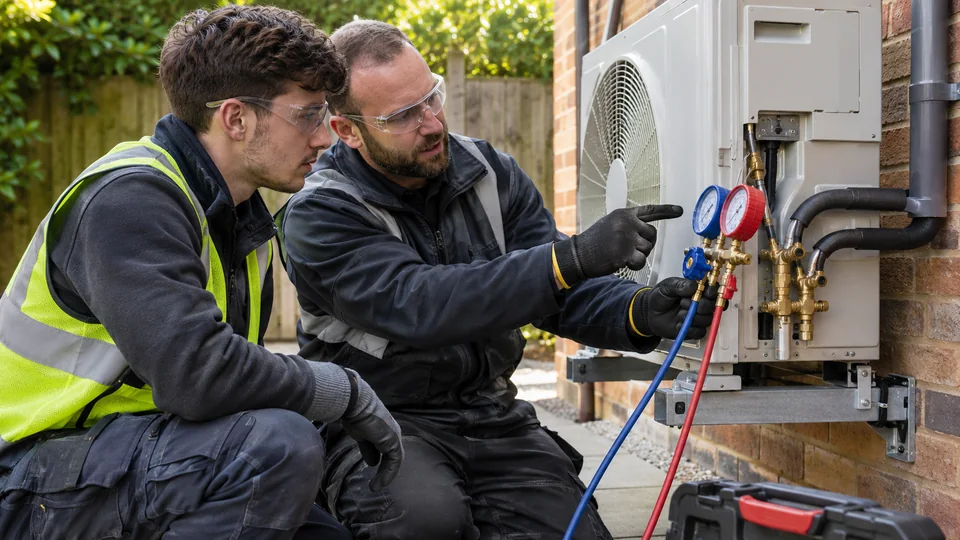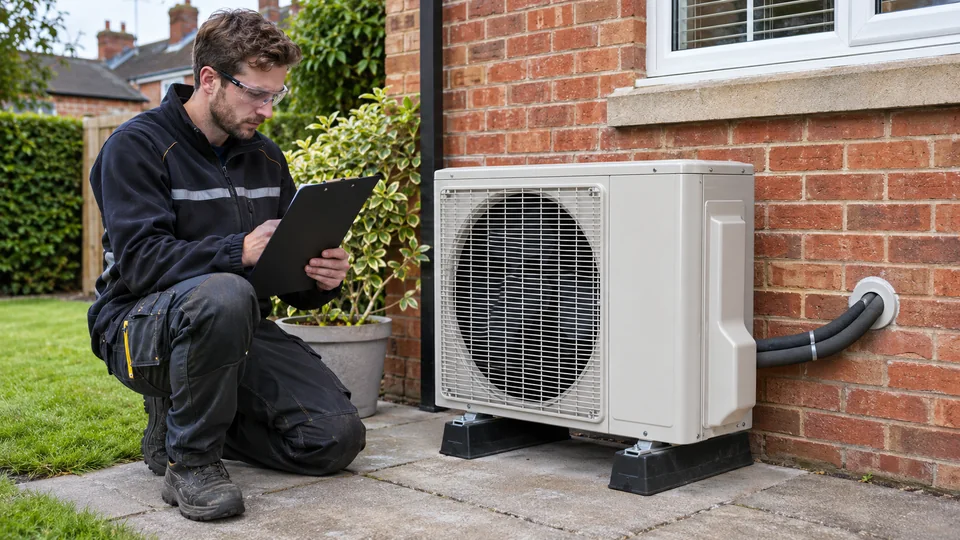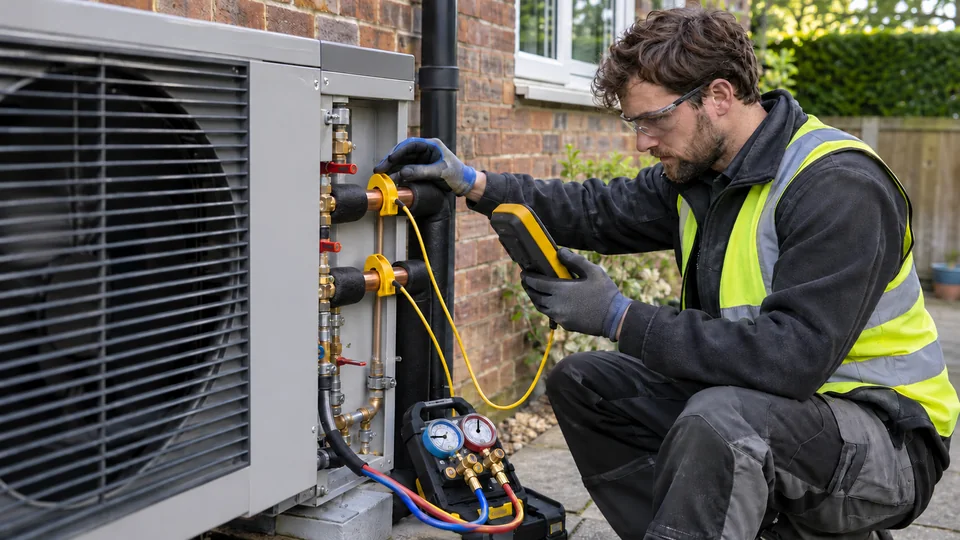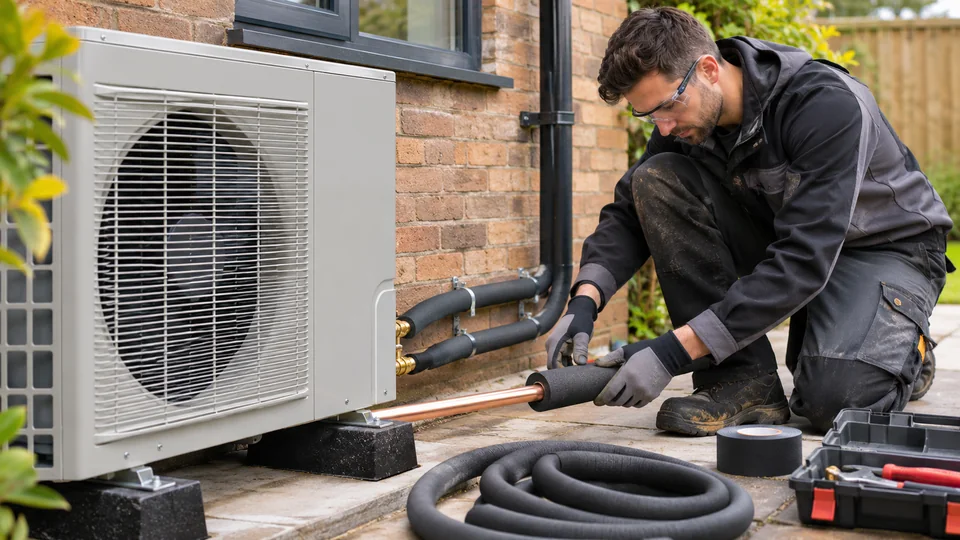
A first split heat pump installation needs preparation across refrigeration, heating-water, electrical and controls work. Experience with a monobloc or a split air conditioner is useful, but neither automatically covers the complete job. Identify the model's requirements and the limits of your own competence before agreeing who will do each part.
The refrigerant connection between indoor and outdoor equipment is a defining consideration on a split system. Where the work involves F-Gas, the appropriate individual qualifications and any required company certification must be in place. Practical coaching supports those qualifications; it does not replace them.
Split and monobloc: understand the boundary
In a typical air-to-water monobloc, the refrigeration circuit is contained within the outdoor unit and water connections run to the building. In a split arrangement, field-installed refrigerant pipework connects the outdoor unit to indoor equipment. Always inspect the actual system design: product names alone are not a reliable guide to every configuration.
That difference changes the site work. Refrigerant pipework preparation, jointing, pressure testing, evacuation and charge requirements need an appropriate plan. Monobloc systems still have refrigerant hazards and may require qualified refrigeration personnel for relevant circuit work; a sealed factory circuit does not make all servicing unrestricted.
Check competence and certification early
Confirm the refrigerant and the work involved. Review the scope of Category 1 if that is your qualification, and check the applicable rules for the location. Do not assume an F-Gas certificate establishes competence with every refrigerant safety class or manufacturer procedure.
Heating design, water treatment, electrical work and controls integration each need suitable expertise. Agree responsibilities before arriving on site. A refrigeration engineer should not be left trying to correct a design issue through refrigerant adjustments, and a heating installer should not be expected to undertake refrigerant work outside their qualifications.
Review the complete installation documents
Obtain instructions for the matched indoor and outdoor units, controller and any accessories. Check location requirements, clearances, pipe lengths, height differences, electrical provisions and commissioning conditions. Confirm which instructions apply to the exact models rather than a similar unit fitted previously.
Plan access and sequencing. Pipework may need inspection before concealment, and heating-water preparation may need to be complete before functional testing. Where another trade's work is not ready, record the limitation and arrange a proper return rather than marking an incomplete commissioning stage as finished.
Keep refrigerant pipework clean and suitable
Use the pipe material, sizes, jointing methods and insulation specified for the equipment. Keep open pipework protected from moisture and debris. Avoid strain at equipment connections and provide appropriate support along the route, including allowance for access and movement where needed.
Follow the prescribed preparation and tightening method for mechanical joints. If brazing is required, it needs suitable competence, fire precautions and the specified contamination-control method. Do not substitute an improvised fitting because it appears to solve an awkward route. Check the actual manufacturer's acceptance of every connection type.
Plan pressure testing and evacuation as separate stages
Pressure testing requires the correct test medium, rated apparatus, defined circuit boundary and model-specific limits. A remembered value from an AC installation is not sufficient. Review common pressure-testing mistakes before selecting equipment or arranging the work.
Evacuation follows the applicable preparation and testing procedure. Measure with a suitable vacuum gauge, understand the connection arrangement and record the required standing result. These stages should produce evidence, not just elapsed pump time and a statement that the system seemed fine.
Commission the refrigerant and heating sides together
The refrigerant circuit cannot deliver useful building performance if water flow, controls or heat distribution are wrong. Verify that the responsible people have completed water-side preparation, required checks and settings. Establish the conditions needed for the manufacturer's commissioning procedure.
Use a general commissioning checklist as a framework, adapted to the heat pump's documentation. Record conditions, settings, refrigerant charge work and functional results. A unit that runs briefly without an alarm has not necessarily demonstrated satisfactory heating operation or control integration.
Expect first-job challenges
Common difficulties include restricted access to service connections, uncertainty about pipe length calculations, unfamiliar controller menus and poor coordination with other trades. Weather and building load can also limit what can be verified during a visit. Plan how those limitations will be recorded and resolved.
If performance is poor, consider systematic heat pump diagnosis before assuming the charge is wrong. Insufficient water flow, sensor placement and unsuitable settings may produce symptoms that look like refrigeration problems. Gather evidence across the whole system before altering it.
Use coaching with clear boundaries
For engineers who are qualified but inexperienced with the task, supervised support can help organise the work and interpret results. Read building confidence after qualifying and define the tasks where you want support. Agree whether the site, equipment and programme allow useful coaching.
F-Gas 1 offers on-site coaching for split heat pumps and AC. Provide the model, refrigerant, your qualification and the planned work when enquiring. For current certification requirements, consult GOV.UK's F-Gas guidance collection and the relevant certification body. Always follow the actual equipment instructions.