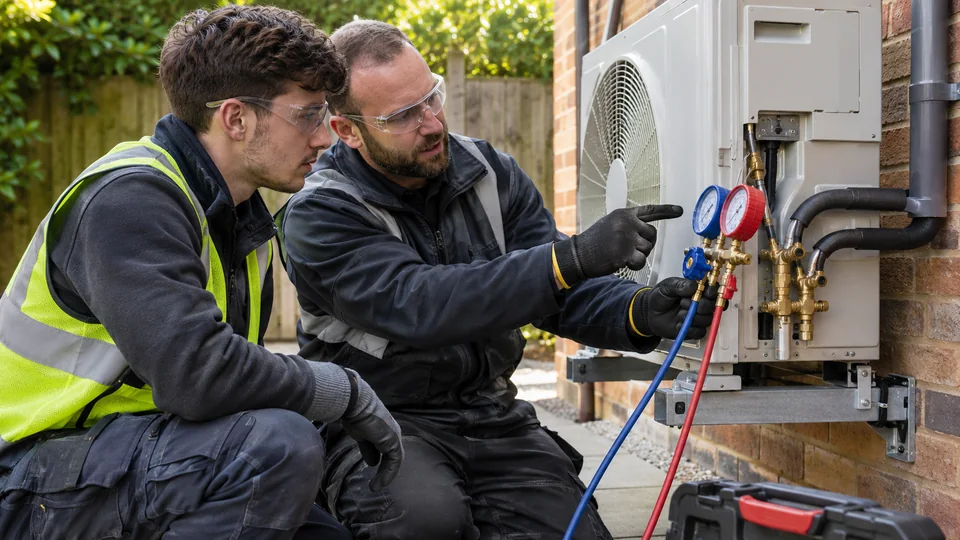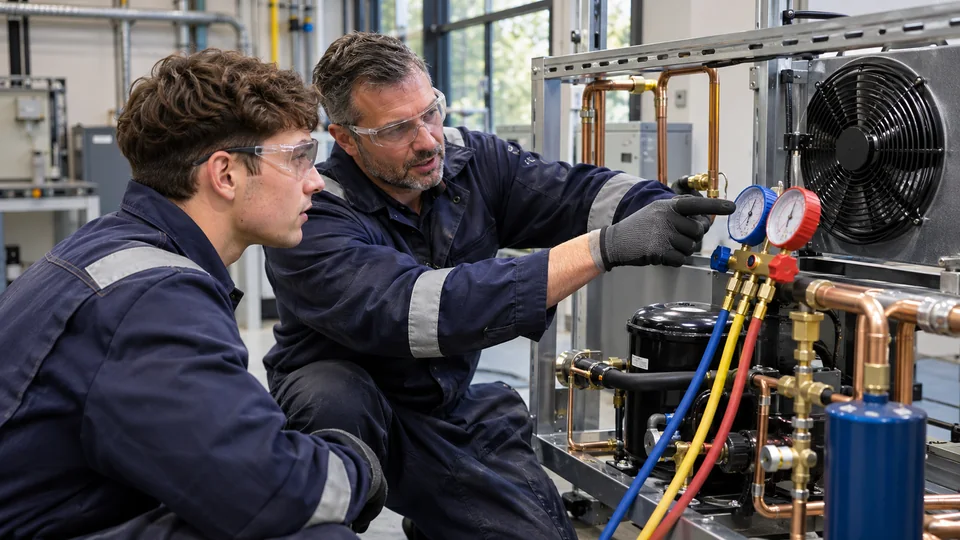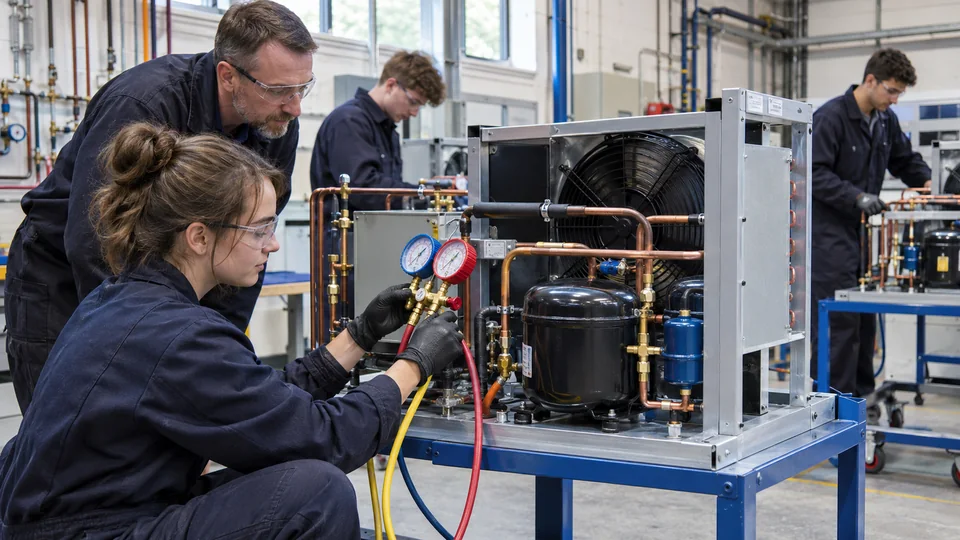
Practical F-Gas training helps learners connect refrigeration theory with the decisions they must make around real equipment. For a training centre, the goal is more than completing a timetable of demonstrations. Learners need opportunities to prepare, practise, explain results and recognise unsafe or unsatisfactory conditions before assessment.
Confidence is useful when it reflects understanding. A learner who can repeat a tool sequence but cannot explain its purpose may struggle when the arrangement changes. Practical sessions should therefore develop reasoning as well as dexterity, within the qualification specification and the centre's approved procedures.
Make the link between theory and equipment explicit
Pressure, temperature, phase change and heat transfer become more meaningful when learners can relate them to a circuit. A tutor can ask where a measurement is taken, what the instrument displays and how an operating condition affects interpretation. The equipment becomes evidence for the explanation rather than a prop beside a lecture.
Avoid treating theory and workshop time as unrelated blocks. Refer back to the principle during the task and revisit it after an unexpected result. That creates a habit of asking why, which is valuable when learners later encounter different systems.
Demonstrate decisions, not just movements
A clear demonstration begins with the purpose, required equipment and checks before starting. Explain the circuit boundary, the relevant instruction and the criteria for an acceptable result. Learners should hear the reasoning behind valve positions and instrument placement, not simply watch hands move.
Pause at meaningful points to check understanding. Ask what would happen if a connection leaked or the instrument were in the wrong location. Keep questions connected to the task, and avoid overwhelming a new learner with every possible fault before they understand the basic arrangement.
Give learners enough supervised practice
Watching a confident tutor can make a task appear simpler than it is. Learners need time to organise equipment and perform the work themselves under appropriate supervision. Observation then reveals whether difficulty concerns knowledge, planning, equipment familiarity or physical technique.
Practice should have a defined outcome and feedback. Record recurring difficulties and plan the next attempt around them. Repeating an entire exercise without discussing the problem may strengthen an error rather than correct it. Encourage learners to explain their setup before proceeding to hazardous stages.
Teach safe working as part of every task
Safety should be visible in preparation, tool checks, cylinder handling, isolation, ventilation and the decision to stop. It is less effective when presented only as a separate opening talk. The workshop arrangement and tutor's own behaviour should reinforce the standard expected from learners.
Use the centre's risk assessments and approved procedures. Explain how to report defective equipment and uncertainty. Learners should see that stopping for a damaged hose or unclear instruction is a professional decision, rather than an inconvenience to the timetable.
Support mixed levels of experience
An experienced installer may be comfortable handling tools but need to correct an established habit. A newcomer may understand a diagram yet require more time to identify components. Neither should be judged solely by apparent confidence at the start of the day.
Use early questions and observation to understand the group. Adjust the pace and explanation while maintaining required standards and authorised assessment conditions. Where a learner needs additional support or a reasonable adjustment, follow the centre's process and awarding requirements rather than making an informal arrangement.
Prepare equipment that supports learning
Rigs, instruments and accessories need to be suitable, maintained and ready for the planned session. A missing adapter or unreliable gauge can consume practice time and introduce misleading results. Confirm the equipment arrangement before learners arrive and provide a clear route for reporting problems.
Where different rigs behave differently, explain the relevant reason rather than presenting every difference as an error. A controlled demonstration of a fault can be useful when properly risk assessed and clearly distinguished from normal operation. Do not create unsafe conditions simply to make a lesson memorable.
Prepare for assessment without reducing training to rehearsal
Learners should understand the assessment scope and expectations through authorised information. Teaching should develop the underlying skills and knowledge, rather than rely on memorising a particular answer or rig sequence. Assessment decisions must remain within the centre's approved arrangements.
Be clear about the distinction between supervised learning and formal assessment. Feedback that is appropriate during practice may not be permissible during an assessment task. A visiting tutor or assessor needs to understand exactly which role they are carrying out at each stage.
Explain what qualification does and does not establish
Successful assessment is an important achievement, but learners still need experience with varied site conditions. Confidence after passing F-Gas explores that transition. Centres can help by encouraging realistic self-assessment and further supervised work within the individual's qualification and competence.
For engineers returning later with specific gaps, focused refresher coaching can be a useful development option. It should be described accurately: practical support does not automatically renew certification or award another qualification.
Use freelance support with a clear brief
An experienced freelance tutor can support planned delivery or cover, provided the centre verifies role suitability and completes induction. Agree the learner profile, qualification, equipment, lesson scope and handover requirements in advance. Our guide to choosing a freelance trainer or assessor suggests questions to ask.
F-Gas 1 offers training delivery support for centres. Share the dates and scope when enquiring. The existing Field notes provides a separate view of practical training and site work; any specific credentials or assessment approvals for an engagement should be verified directly through the centre's usual checks.